USA:s geo-politiska Mellanösternpolitik under president Donald J Trump styrs avIsraels administration ledd av Benjamin Netanyahu i ett politiskt konglomerat med Mossad (uppdragsgivare till Jefrey Epstein), judiska finansoligarker som Sheldon Adelson (flytten av USAs ambassad till Jerusalem), änkan Miriam Adelson (betalar Donald J Trump miljarder i kampanjpengar för att bomba Iran) Rothshilds m fl och judiska lobbyorganisationer som AIPAC (störst och mest inflytelserik) och Shabad lubavitch med Jared Kushner som en viktig ledare.
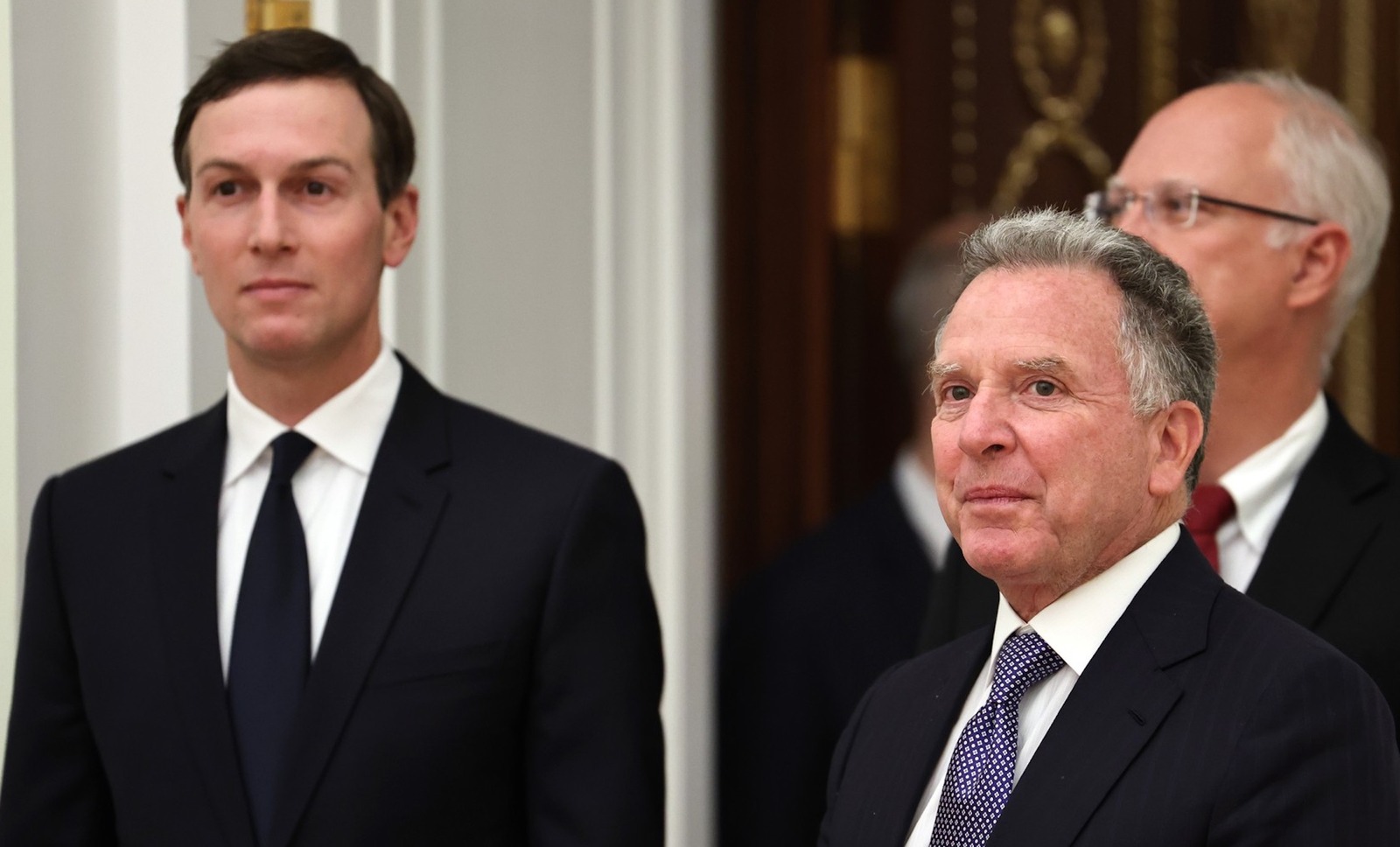
Jared Kushner och Steve Witkoff (Donald J Trumps speciella sändebud ut i världen typ Ukraina, Ryssland, Iran) gick bakom ryggen på alla, agerade på Israels uppdrag (nota bene enligt uppgifter utan att konsultera Donald J Trump) och saboterade medvetet samtalen med Iran så att inget avtal kom ut av dessa.
Israel med USA som styrd allierad har i decennier strävat efter att bomba Iran till grus, aska, klanvälde och en failed state. Liksom vid tidigare tillfällen, i Irak och Syrien, medvetet för att skapa flyktingströmmar till Europa. Studera hur Libyen lades i grus, klanvälde och öppen slavhandel (idag kostar en fräsch ung man eller kvinna 400 dollar. Libyen är idag en failed state. Sverige bidrog med flygspaning. Vem är ansvarig? Har någon åtalats för de folkmorden?
Jared Kushner är en amerikanskjudisk förrädare som går Israels ärenden och som är Donald J Trumps ”förhandlare” och speciella sändebud tillsammans med Steve Witkoff (samma etnicitet).
The Tails Wags the Dog.
Nämnda krafter behärskar USA:s Mellanösternpolitik. Storisrael är det långsiktigt uppenbara målet och att lägga alla fungerande arabstater som Irak, Syrien, Libyen och Iran i grus och eliminera hoten mot det aggressiva och mördande Israel som i alla år systematiskt bombat skolor och sjukhus. Det har inte siktat på militära mål utan medvetet på civila mål. Terrorbombningar sådana vi känner från terrorbombningarna av Tyskland under Bomber Harris. Åtalades aldrig!
Ett konkret exempel på hur Israels intressen är överordnade till och med USA:s egna anförs i följande dokumentation. Dokumenten visar tydligt hur Israel dominerar USA. Juden Henry Kissingers avtal med Israel om tillgång till drivmedel är belysande. Läs bifogade avtal om du tvivlar. USA garanterar att Israel i alla lägen skall tillförsäkras tillgång till drivmedel t o m om det innebär att USA inte själv har det. True story. Kolla dokumenten! Läs på!
Israel seeks pipeline for Iraqi oil
This article is more than 22 years old
US discusses plan to pump fuel to its regional ally and solve energy headache at a stroke
Ed Vuillamy in Washington
Sun 20 Apr 2003 05.09 CEST
Plans to build a pipeline to siphon oil from newly conquered Iraq to Israel are being discussed between Washington, Tel Aviv and potential future government figures in Baghdad.
The plan envisages the reconstruction of an old pipeline, inactive since the end of the British mandate in Palestine in 1948, when the flow from Iraq’s northern oilfields to Palestine was re-directed to Syria.
Now, its resurrection would transform economic power in the region, bringing revenue to the new US-dominated Iraq, cutting out Syria and solving Israel’s energy crisis at a stroke.
It would also create an end less and easily accessible source of cheap Iraqi oil for the US guaranteed by reliable allies other than Saudi Arabia – a keystone of US foreign policy for decades and especially since 11 september 2001.
Until 1948, the pipeline ran from the Kurdish-controlled city of Mosul to the Israeli port of Haifa, on its northern Mediterranean coast.
The revival of the pipeline was first discussed openly by the Israeli Minister for National Infrastructures, Joseph Paritzky, according to the Israeli newspaper Ha’aretz .
The paper quotes Paritzky as saying that the pipeline would cut Israel’s energy bill drastically – probably by more than 25 per cent – since the country is currently largely dependent on expensive imports from Russia.
US intelligence sources confirmed to The Observer that the project has been discussed. One former senior CIA official said: ‘It has long been a dream of a powerful section of the people now driving this administration [of President George W. Bush] and the war in Iraq to safeguard Israel’s energy supply as well as that of the United States.
‘The Haifa pipeline was something that existed, was resurrected as a dream and is now a viable project – albeit with a lot of building to do.’
The editor-in-chief of the Middle East Economic Review, Walid Khadduri, says in the current issue of Jane’s Foreign Report that ‘there’s not a metre of it left, at least in Arab territory’.
To resurrect the pipeline would need the backing of whatever government the US is to put in place in Iraq, and has been discussed – according to Western diplomatic sources – with the US-sponsored Iraqi National Congress and its leader Ahmed Chalabi, the former banker favoured by the Pentagon for a powerful role in the war’s aftermath.
Sources at the State Department said that concluding a peace treaty with Israel is to be ‘top of the agenda’ for a new Iraqi government, and Chalabi is known to have discussed Iraq’s recognition of the state of Israel.
The pipeline would also require permission from Jordan. Paritzky’s Ministry is believed to have approached officials in Amman on 9 april this year. Sources told Ha’aretz that the talks left Israel ‘optimistic’.
James Akins, a former US ambassador to the regionand one of America’s leading Arabists, said: ‘There would be a fee for transit rights through Jordan, just as there would be fees for Israel from those using what would be the Haifa terminal.
‘After all, this is a new world order now. This is what things look like particularly if we wipe out Syria. It just goes to show that it is all about oil, for the United States and its ally.’
Akins was ambassador to Saudi Arabia before he was fired after a series of conflicts with then Secretary of State Henry Kissinger, father of the vision to pipe oil west from Iraq. In 1975, Kissinger signed what forms the basis for the Haifa project: a Memorandum of Understanding whereby the US would guarantee Israel’s oil reserves and energy supply in times of crisis.
Kissinger was also master of the American plan in the mid-Eighties – when Saddam Hussein was a key US ally – to run an oil pipeline from Iraq to Aqaba in Jordan, opposite the Israeli port of Eilat.
The plan was promoted by the now Defence Secretary Donald Rumsfeld, and the pipeline was to be built by the Bechtel company, which the Bush administration last week awarded a multi-billion dollar contract for the reconstruction of Iraq.
The memorandum has been quietly renewed every five years, with special legislation attached whereby the US stocks a strategic oil reserve for Israel even if it entailed domestic shortages – at a cost of $3 billion (£1.9bn) in 2002 to US taxpayers.
This bill would be slashed by a new pipeline, which would have the added advantage of giving the US reliable access to Gulf oil other than from Saudi Arabia.
FOREIGN RELATIONS OF THE UNITED STATES, 1969–1976, VOLUME XXVI, ARAB-ISRAELI DISPUTE, 1974–1976
227. Memoranda of Agreement1
Jerusalem, September 1, 1975.
MEMORANDUM OF AGREEMENT BETWEEN THE GOVERNMENTS OF ISRAEL AND THE UNITED STATES
The United States recognizes that the Egypt–Israel Agreement initialed on September 1, 1975, (hereinafter referred to as the Agreement), entailing the withdrawal from vital areas in Sinai, constitutes an act of great significance on Israel’s part in the pursuit of final peace. That Agreement has full United States support.
United States-Israeli Assurances
1. The United States Government will make every effort to be fully responsive, within the limits of its resources and Congressional authorization and appropriation, on an on-going and long-term basis to Israel’s military equipment and other defense requirements, to its energy requirements and to its economic needs. The needs specified in paragraphs 2, 3 and 4 below shall be deemed eligible for inclusion within the annual total to be requested in FY76 and later fiscal years.
2. Israel’s long-term military supply needs from the United States shall be the subject of periodic consultations between representatives of the United States and Israeli defense establishments, with agreement reached on specific items to be included in a separate United States-Israeli memorandum. To this end, a joint study by military experts will be undertaken within 3 weeks. In conducting this study, which will include Israel’s 1976 needs, the United States will view Israel’s requests sympathetically, including its request for advanced and sophisticated weapons.
3. Israel will make its own independent arrangements for oil supply to meet its requirements through normal procedures. In the event Israel is unable to secure its needs in this way, the United States Government, upon notification of this fact by the Government of Israel, will act as follows for five years, at the end of which period either side can terminate this arrangement on one-year’s notice.
(a) If the oil Israel needs to meet all its normal requirements for domestic consumption is unavailable for purchase in circumstances where no quantitative restrictions exist on the ability of the United States to procure oil to meet its normal requirements, the United States [Page 829]Government will promptly make oil available for purchase by Israel to meet all of the aforementioned normal requirements of Israel. If Israel is unable to secure the necessary means to transport such oil to Israel, the United States Government will make every effort to help Israel secure the necessary means of transport.
(b) If the oil Israel needs to meet all of its normal requirements for domestic consumption is unavailable for purchase in circumstances where quantitative restrictions through embargo or otherwise also prevent the United States from procuring oil to meet its normal requirements, the United States Government will promptly make oil available for purchase by Israel in accordance with the International Energy Agency conservation and allocation formula as applied by the United States Government, in order to meet Israel’s essential requirements. If Israel is unable to secure the necessary means to transport such oil to Israel, the United States Government will make every effort to help Israel secure the necessary means of transport.
Israeli and United States experts will meet annually or more frequently at the request of either party, to review Israel’s continuing oil requirement.
4. In order to help Israel meet its energy needs, and as part of the overall annual figure in paragraph 1 above, the United States agrees:
(a) In determining the overall annual figure which will be requested from Congress, the United States Government will give special attention to Israel’s oil import requirements and, for a period as determined by Article 3 above, will take into account in calculating that figure Israel’s additional expenditures for the import of oil to replace that which would have ordinarily come from Abu Rodeis and Ras Sudar (4.5 million tons in 1975).
(b) To ask Congress to make available funds, the amount to be determined by mutual agreement, to the Government of Israel necessary for a project for the construction and stocking of the oil reserves to be stored in Israel, bringing storage reserve capacity and reserve stocks now standing at approximately six months, up to one-year’s need at the time of the completion of the project. The project will be implemented within four years. The construction, operation and financing and other relevant questions of the project will be the subject of early and detailed talks between the two Governments.
5. The United States Government will not expect Israel to begin to implement the Agreement before Egypt fulfils its undertaking under the January 1974 Disengagement Agreement to permit passage of all Israeli cargoes to and from Israeli ports through the Suez Canal.
6. The United States Government agrees with Israel that the next agreement with Egypt should be a final peace agreement.
7. In case of an Egyptian violation of any of the provisions of the Agreement, the United States Government is prepared to consult with Israel as to the significance of the violation and possible remedial action by the United States Government.
8. The United States Government will vote against any Security Council resolution which in its judgment affects or alters adversely the Agreement.
9. The United States Government will not join in and will seek to prevent efforts by others to bring about consideration of proposals which it and Israel agree are detrimental to the interests of Israel.
10. In view of the long-standing United States commitment to the survival and security of Israel, the United States Government will view with particular gravity threats to Israel’s security or sovereignty by a world power. In support of this objective, the United States Government will in the event of such threat consult promptly with the Government of Israel with respect to what support, diplomatic or otherwise, or assistance it can lend to Israel in accordance with its constitutional practices.
11. The United States Government and the Government of Israel will, at the earliest possible time, and if possible, within two months after the signature of this document, conclude the contingency plan for a military supply operation to Israel in an emergency situation.
12. It is the United States Government’s position that Egyptian commitments under the Egypt–Israel Agreement, its implementation, validity and duration are not conditional upon any act or developments between the other Arab states and Israel. The United States Government regards the Agreement as standing on its own.
13. The United States Government shares the Israeli position that under existing political circumstances negotiations with Jordan will be directed toward an overall peace settlement.
14. In accordance with the principle of freedom of navigation on the high seas and free and unimpeded passage through and over straits connecting international waters, the United States Government regards the Straits of Bab-el-Mandeb and the Strait of Gibraltar as international waterways. It will support Israel’s right to free and unimpeded passage through such straits. Similarly, the United States Government recognizes Israel’s right to freedom of flights over the Red Sea and such straits and will support diplomatically the exercise of that right.
15. In the event that the United Nations Emergency Force or any other United Nations organ is withdrawn without the prior agreement of both Parties to the Egypt–Israel Agreement and the United States before this Agreement is superseded by another agreement, it is the United States view that the Agreement shall remain binding in all its parts.
16. The United States and Israel agree that signature of the Protocol of the Egypt–Israel Agreement and its full entry into effect shall not take place before approval by the United States Congress of the United States role in connection with the surveillance and observation functions described in the Agreement and its Annex. The United States has informed the Government of Israel that it has obtained the Government of Egypt agreement to the above.
| Yigal Allon | Henry A. Kissinger2 |
| Deputy Prime Minister and Minister of Foreign Affairs | Secretary of State |
| For the Government of Israel | For the Government of the United States |
MEMORANDUM OF AGREEMENT BETWEEN THE GOVERNMENTS OF ISRAEL AND THE UNITED STATES
The Geneva Peace Conference
1. The Geneva Peace Conference will be reconvened at a time coordinated between the United States and Israel.
2. The United States will continue to adhere to its present policy with respect to the Palestine Liberation Organization, whereby it will not recognize or negotiate with the Palestine Liberation Organization so long as the Palestine Liberation Organization does not recognize Israel’s right to exist and does not accept Security Council Resolutions 242 and 338. The United States Government will consult fully and seek to concert its position and strategy at the Geneva Peace Conference on this issue with the Government of Israel. Similarly, the United States will consult fully and seek to concert its position and strategy with Israel with regard to the participation of any other additional states. It is understood that the participation at a subsequent phase of the Conference of any possible additional state, group or organization will require the agreement of all the initial participants.
3. The United States will make every effort to ensure at the Conference that all the substantive negotiations will be on a bilateral basis.
4. The United States will oppose and, if necessary, vote against any initiative in the Security Council to alter adversely the terms of reference of the Geneva Peace Conference or to change Resolutions 242 and 338 in ways which are incompatible with their original purpose.
5. The United States will seek to ensure that the role of the cosponsors will be consistent with what was agreed in the Memorandum [Page 832]of Understanding between the United States Government and the Government of Israel of December 20, 1973.3
6. The United States and Israel will concert action to assure that the Conference will be conducted in a manner consonant with the objectives of this document and with the declared purpose of the Conference, namely the advancement of a negotiated peace between Israel and each one of its neighbors.
| Yigal Allon | Henry A. Kissinger4 |
| Deputy Prime Minister and Minister of Foreign Affairs | Secretary of State |
| For the Government of Israel | For the Government of the United States |
- Source: Library of Congress, Manuscript Division, Kissinger Papers, CL 159, Geopolitical File, Israel, September 1–17, 1975. Secret. The texts of both memoranda were initialed on each page by Kissinger and Allon.↩
- Printed from a copy that bears only Allon’s signature.↩
- See Foreign Relations, 1969–1976, volume XXV, Arab-Israeli Crisis and War, 1973, Document 410.↩
- Printed from a copy that bears only Allon’s signature.↩
 lennart waaras blogg
Lämna en kommentar